asylum seekers · human rights

Ramadan in Villawood- as featured in ABC’s The Drum

My latest feature in ABC’s The Drum.

Villawood detention centre.

Surviving Ramadan in Villawood

Feature: For many asylum seekers who experience a sense of hopelessness and isolation inside Villawood Detention Centre, Ramadan is a source of spiritual sustenance.

It’s iftar time in Sydney’s Villawood Detention Centre.

Plastic containers bursting with hummus, tabouli, garlic sauce and kebab snake their way through security and are picked up by hungry fasting asylum seekers in the visitor’s centre.

In the open courtyard around 30 asylum seekers, mostly men, gather around tables piled with the food, exhaling plumes of smoke as they rub their hands together for warmth and wait for sundown.

As Muslims around the world sit down to huge feasts at Ramadan surrounded by loved ones, it’s a lonely and fraught affair for asylum seekers inside Villawood.
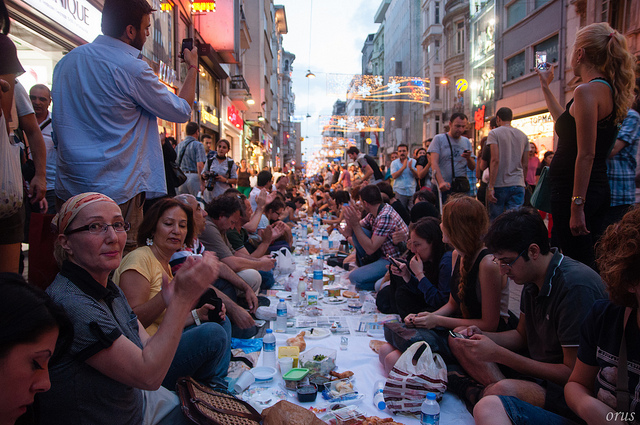
Street iftar in Turkey. Picture: Flickr/ Alper Orus

Asylum seeker Iqbal* says being away from family and friends has been tough. “It is very painful. Nothing is like home when it comes to Ramadan,” he said.

Ramadan is a holy month for Muslims who abstain from food and drink during the daylight hours, with an increased focus on devotion and prayer.

“It is a very holy month for us,” Iqbal said. “People who are not practicing other months, they become practising this month.”

For many asylum seekers who experience a sense of hopelessness and isolation inside, Ramadan is a source of spiritual sustenance.

“It is as important as seeing a mental health counsellor,” Iqbal said. He says many of the men who are reluctant to express themselves will openly cry during prayer.

“This is how we are still coping. That’s what’s keeping us alive, keeping us going, faith and belief in God.”

The asylum seekers are grateful for the delicious food delivered from outside, a welcome relief from the standard issue dinner.

The nightly deliveries facilitated by the Lebanese Muslim Association are funded by a rotation of private donors from the Muslim community.

Earlier in the month, food was not delivered because of limits around amounts allowed in, to be accompanied by a certain amount of visitors, Iqbal said.

“Sometimes we asked why there is no food came today. We found out later they were stopped and refused entry,” he said.

A LMA spokesperson said there were difficulties delivering food to the centre during the first few days of Ramadan.

“By now after all this time they (authorities) should know about this (Ramadan),” he said.

A recent rule change meant food was not allowed to be brought back into the private rooms of asylum seekers from the central visitors area, Iqbal said.

The rule fuelled wastage as fasting asylum seekers struggled to finish their allocation in a short period.

“(The idea being) we’ll let you bring in food but we won’t let you enjoy it,” Iqbal said.

“Little people have a little authority and they are just abusing it.”

In the centre, the men munch the food in the cold before returning to their rooms for solitary prayer.

Iqbal says a petition has been made for a room asylum seekers can gather in for congregational prayer.

“To cope in this situation we need that. When they make us pray alone in our rooms, we feel even more lonely and the toll becomes hard on us,” he said.

“They should provide a good facility because we are not criminals. We are not inmates.”

As night falls in Villawood, food containers are hastily packed as visitors say their final goodbyes and exit the mesh of wire and steel.

For those remaining, there is hope that someone, somewhere is listening, hoping, praying.

“We are the silenced ones. People don’t know about us,” Iqbal said.

A copy obtained of Villawood detention centre general manager Susan Noordink’s response to an official complaint made by fasting asylum seekers says standard conditions are being enforced.

“In regards to Ramadan food from the community, Islamic detainees have been advised that all standard conditions of entry will be in force,” Ms Noordink said.

“All community groups must abide by approved visits policy as provided by management and posted in notification in the Gatehouse and the visits area.”

The statement also said arrangements will be made to facilitate prayer areas for asylum seekers.

*Name has been changed at the request of the asylum seeker

RELATED LINKS

CHECK OUT: At work inside our detention centres: A guard’s story 

This article was originally published on ABC’s The Drum (http://www.abc.net.au/thedrum). Read the original article here (http://www.abc.net.au/news/2015-07-15/malik-ramadan-in-villawood/6621034).

human rights · islam · media · racism · religion

Stop the dog whistling on radicalisation, Minister- as featured in ABC’s The Drum

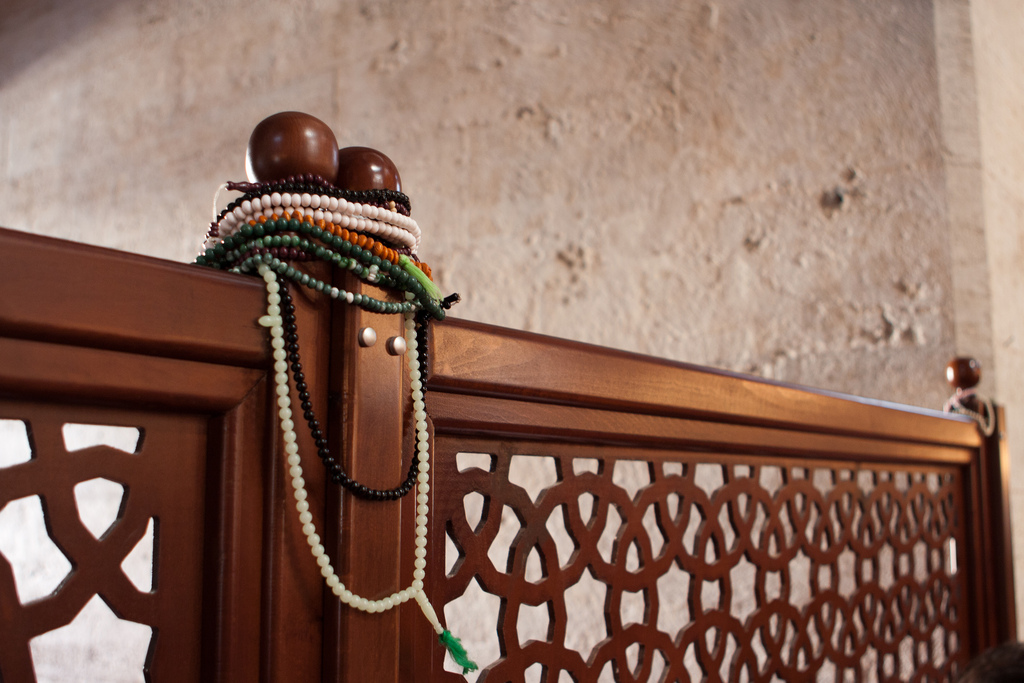
tasbih
Muslims are framed as a ‘problem to be solved’ by political leaders. Picture: Flickr/ Brian Jeffery Beggarly.

Andrew Robb wants quick fixes and easy answers for the problem of radicalisation, but his framing of the “Muslim” as a problem to be solved isn’t helping one bit, writes Sarah Malik.

My phone is exploding with Happy Eid! texts.

Except it’s not Eid. Not for me at least.

The texts are mainly from my well-meaning white friends who have watched Eid celebrations at Lakemba mosque on Channel Nine.

I’m celebrating the next day, like half the rest of the state’s Muslims. The old school method of marking the end of Ramadan involves waiting to see the arc of the new moon indicating the beginning of the lunar month as opposed to the fixed scientific calendar method.

This is one of the million fine details of the complex and diverse Muslim communities who hail from dozens of varied cultures and strains, but are forced into a uniformity by an external culture that imposes modes of understanding aligned with its own understandings of religious ritual, politics and practice.

Chief among these is the myth of a unified and Vatican-like leadership hierarchy Andrew Robb seems to be appealing to in his demands on ABC’s Q&A on Monday night that Muslim leaders pull in their radicalised youth.

One of the great attractions of Sunni Islam is the lack of hierarchical or mediating priest-class, with a focus on the individual’s direct relationship to God.

Sure there are imams who lead prayer, and scholars who have spent years nutting out points of law, and an axis of orthodoxy most mainstream leaders are guided by. Beyond that, leaders are made more by their following and popularity rather than anointed by overarching councils or bodies.

This makes things difficult for politicians like Mr Robb, who needs someone to cop the flak for the rash of young nutcases running to the Middle East.

When it’s young Muslim men, the community is expected to take responsibility.

Only when it’s a young white male like Jake Bilardi, there is a recognition of the risk faced by young, isolated people with complex personal compulsions and histories that make them vulnerable to the call of extremism.

There is a barrage of material trying to understand the lure of militancy. Is it the search for belonging? Alienation and marginalisation? Anger at foreign intervention in the Muslim world? The promise of an Islamic golden age utopia in the face of political humiliation? Sex and kittens? The internet? An outlet for existing criminal tendencies, or just a way to escape the tedium of ordinary life?

One thing remains clear, there seems to be no one-size-fits-all approach to the trajectory of these lone and few individuals who often leave behind their own baffled and distraught families and communities.

These few individuals rarely interact with mainstream leaders or mosques. Like most young people, not just Muslims, traditional religious authorities (read: old people) have failed to connect with the millennials’ quest for meaning in a changing social media world.

This is not necessarily a bad thing.

The internet, like most things, is a reflection of the people who use it.

Social media provides communities for minorities rarely given a voice in the mainstream. Hamza Yusuf and Ustadh Nouman Ali Khan are among a spate of celebrity sheikhs that have connected online with global youth audiences.

They successfully market a homegrown western Islam, that despite their detractors is grounded in the world migrant kids can understand and for all its conservatism generally stress political participation and integration.

Mr Robb wants quick fixes and easy answers for the problem of radicalisation.

There is one simple one that I can offer free of charge.

The constant framing of the “Muslim” as a problem to be solved by politicians and media who use these communities to whip up ratings and dog whistle politics is a disgrace. It is far disproportionate to any risks posed.

It only adds to the genuine anguish of Muslim communities struggling against a small but virulent association of extremism with the added burden of racial aggression and hysteria.

This article was originally published on ABC’s The Drum (http://www.abc.net.au/thedrum). Read the original article here (http://www.abc.net.au/news/2015-04-22/malik-stop-the-dog-whistling-on-radicalisation-minister/6411074).

feminism · human rights · injustice · interview · islamic law · media · muslim women · politics · religion

Heroes and heretics

Islamic scholar Amina Wadud has been branded both a heroine and a  heretic.

Heroine for her academic framework for Muslims in legal and policy reform  around the world; heretic for leading a mixed gender prayer in New York in 2005  which made worldwide headlines.

The prayer session propelled the 58-year-old African American into celebrity  Muslim reformer status, a position the theologian does not seem entirely  comfortable with.

“I try to keep my sense of humour about it,” she said, speaking in Sydney  after engagements in Melbourne and Canberra.

“I didn’t play into it. I didn’t stoke the sensationalism of it.

“The time was a little bit comical but I could not live along those lines. I  like the basic parts of my life where you have anonymity.”

Asked if the controversy had obscured her long-time activism and scholarship  on Islam and gender issues, she said: “I regret things being obscured for any  reason. But I do not regret the prayer if that is reason why people obscure  things. People have not been pleased with my work for a long time. So the prayer  is just a ruse … and … excuse for not listening to what you have to say.”

Dr Wadud is the author of several books, including Quran and Women:  Re-reading the sacred text from a woman’s perspective and Inside Gender  Jihad: Women’s reform in Islam.

Her central thesis is that for centuries Islam has been interpreted by male  scholars which has obscured its essentially egalitarian ethos. This ethos, Dr  Wadud says, has inspired her reform work particularly around Islamic family  law.

While her religious detractors accuse her of heresy, other criticisms of Dr  Wadud involve the charge that she feeds into the never-ending contestation of  religious texts which has no purpose in the modern era within a secular  framework. However, her books have worked as a framework for Muslim activists,  particularly through lobby groups and her organisation, Sisters in Islam in  Malaysia.

One of Dr Wadud’s central ideas is that as a believer she accepts the  divinity of the Qur’an, however, its readings must always be open to scrutiny  and re-evaluation. This is particularly important if laws are to be based on its  precepts and have impact in the real world on women’s lives.

Born in the American South, in Maryland in 1952, to a Methodist preacher  father, Dr Wadud converted to Islam at university at the age of 20 after a brief  stint as a practicing Buddhist.

“I was a practicing Buddhist for a year,” she said.

“I came across Islam and it grew exponentially and I came to an understanding  of the universe that worked for me.”

The liberation theology of the black leaders of the civil rights movement and  her own upbringing also influenced her.

“My family situation was one where the relationship between social injustice  and faith was explicit. You do not oppress. Oppression is against God’s will,” she said.

“I grew up in the era of black consciousness. I lived in a transformative  time as a young person- you could hear and feel you had a certain sense of  social responsibility – a mandate to fight to remove injustice as it was being  established in the context of our lives as African Americans.

“I was brought up in the revolutionary spirit of justice and it was common  sense to transfer that in terms of Islam and gender justice.”

Dr Wadud, a devout and thoughtful woman, finds much of the hype around her  work distasteful, so much so that at one point she eschewed the label ‘feminist’  altogether.

“There are obviously large sectors of non-Muslim and Muslim population who  think Islamic feminism is an oxymoron,” she said.

“I am less concerned now about whether or not I make everyone comfortable in  terms of the self designation (of being feminist) than at another point.”

She said the term ‘feminism’ often led people to dismiss her work.

” … I feel a little bit more comfortable in my own skin being able to say  feminist. At another point [I would avoid the label] in order to avoid the  politics of the discussion and to avoid the marginalisation of my work into  those politics,” Dr Wadud said.

This perceived incompatibility is incongruous with her own study of Islamic  thought and philosophical thinking.

“They are limiting feminism from its own intellectual and political history,”  she said. “They are also limiting Islam from its own egalitarian  trajectory.”

Dr Wadud has found crowd hostility toward her more pointed in Sydney than  Melbourne, where the largely Muslim audience seemed much more engaged.

Her lecture this week at the University of Technology, Sydney, involved  several heated exchanges with young men.

“Some people in the Australian audiences, they come because they’ve heard  there is something wrong or bad or evil about me,” she said.

“They come because they will set me straight. When they get here and I don’t  say anything outrageous for them to pick up on – they make up stuff.”

Dr Wadud finds arguments with those who have not even read her ideas tiring  and is now focussed on reaching out to those who have.

“In the past I felt a much greater responsibility to be understood by as many  people as possible,” she said.

“You spent all your time trying to convert people who are absolutely  unconvinced about where you’re going.

“Then there are some people who are trying to understand certain things and  have a nominal level of agreement and maybe want to go further and engage with  your ideas. That’s a more interesting level to engage.”

There have been rumours of death threats, but Dr Wadud is quick to clear the  air.

“I never received any death threats,” she laughs.

“There was this thing where people got into saying I had death threats.  But  I never had anyone actually threaten me.”

From SMH

culture · human rights · islamic law · law · Pakistan · politics · religion

Pakistan’s traditional spirituality hijacked?

Every week sees a fresh wave of violence strike Pakistan. Just two days ago, a suicide car bomb in a crowded shopping street in the north-west town of Charsadda killed almost 20 people and injured dozens. It was the third such incident in three days. These follow blasts in Rawalpindi and Peshawar, which killed dozens in crowded marketplaces, the latter of which coincided with US Secretary of State Hillary Clinton’s visit.

The violence has put many Pakistanis on edge, many blaming the country’s relationship with the US. They point to the loss of civilian lives in badly aimed drone attacks and a historical relationship that suggests the US looks after its own interests and should not be trusted.

The Obama Administration finds itself dealing with partners in both Pakistan and Afghanistan who do not have the strong mandate of their people, with Hamid Karzai’s recent win in a one-man election in Afghanistan, and Asif Ali Zardari in Pakistan, who as widow of former prime minister Benazir Bhutto has benefited from a Bhutto stranglehold on the ruling Pakistani People’s Party despite being mired in corruption. The shadowy standing of the two leaders threatens the legitimacy of the partnership.

The current Administration has done well in bypassing the leadership and attempting to reach out to the people through cultural dialogue with frank meetings with media professionals and students. Clinton’s visit wearing a billowing blue dupatta to a Sufi shrine in Islamabad moved many and represents in many ways the true spirit of Pakistani spirituality, which has been hijacked in recent years with the rise of extremism.

In the past 10 years, I have seen a steady shift to the right. The folk spirituality of Pakistan, traditionally involving a mixture of Islamic Sufism and saint worship, has given way to a more puritanical form of Islam, which shuns Shiite Muslims and other minorities. Weddings are increasingly segregated and without the traditional Pakistani music and dance that make them so lively. The dupatta, a deliciously sheer piece of cloth worn with colourful shalwar kameez as part of the traditional dress, have given way to burqas and niqabs in certain areas.

The contradictions that lie at Pakistan’s fractured soul are emblematic of its very origin. Pakistan’s founder, Mohammad Ali Jinnah, a secularist and English-trained lawyer, initially used religion as nationalistic rallying cry and political tool for the creation of Pakistan. This backfired badly with Pakistan fighting for its national identity ever since. The question being if Pakistan was created in 1947 as a homeland for the subcontinent’s Muslims than why should it not also be an Islamic State? The historical Jinnah in Pakistan has been transmogrified into a pious, sherwani wearing “Quad-e Azam” or “Great leader”. This image is a far cry from the man found in the Jinnah museum in Karachi who was fond of his suits and cigars.

This is symptomatic of unease with which Pakistan has dealt with the religious question. It seems it does not have the ideological courage to be either an Iran or Turkey but will settle for being both and something in between.

The majority of Pakistanis are moderate, this can be seen in elections where Islamist parties have consistently received a small minority of the vote. If ideologically speaking, Pakistanis are scattered, the building of institutions will be a bulwark against excesses. The lack of education, health, literacy and poor state of women’s rights have put Pakistan at the risk of a kind of national myopia.

Democracy depends as much on the healthy state of an informed public as a free election. The rise of the lawyer’s movement, which protested against former military dictator Pervez Musharraf ‘s move to force out Supreme Court justice Iftikhar Mohammed Chaudhry in 2007, to the creation of community run police-citizen patrols to deal with law and order issues show that the Pakistani people have developed ingenuity to deal with its social problems despite an ineffectual state apparatus. A government whose only occupation seems to be to repeatedly fund and create militant groups it quickly loses control over and an obsessive rivalry with neighbour India.

Pakistanis can only dream of the possibilities of not struggling under the weight of this monstrous disability.