Feature: For many asylum seekers who experience a sense of hopelessness and isolation inside Villawood Detention Centre, Ramadan is a source of spiritual sustenance.
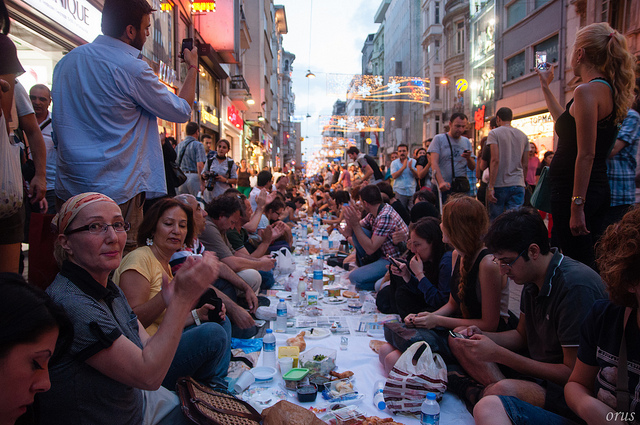
It’s iftar time in Sydney’s Villawood Detention Centre.
Plastic containers bursting with hummus, tabouli, garlic sauce and kebab snake their way through security and are picked up by hungry fasting asylum seekers in the visitor’s centre.
In the open courtyard around 30 asylum seekers, mostly men, gather around tables piled with the food, exhaling plumes of smoke as they rub their hands together for warmth and wait for sundown.
As Muslims around the world sit down to huge feasts at Ramadan surrounded by loved ones, it’s a lonely and fraught affair for asylum seekers inside Villawood.
Asylum seeker Iqbal* says being away from family and friends has been tough. “It is very painful. Nothing is like home when it comes to Ramadan,” he said.
Ramadan is a holy month for Muslims who abstain from food and drink during the daylight hours, with an increased focus on devotion and prayer.
“It is a very holy month for us,” Iqbal said. “People who are not practicing other months, they become practising this month.”
For many asylum seekers who experience a sense of hopelessness and isolation inside, Ramadan is a source of spiritual sustenance.
“It is as important as seeing a mental health counsellor,” Iqbal said. He says many of the men who are reluctant to express themselves will openly cry during prayer.
“This is how we are still coping. That’s what’s keeping us alive, keeping us going, faith and belief in God.”
The asylum seekers are grateful for the delicious food delivered from outside, a welcome relief from the standard issue dinner.
The nightly deliveries facilitated by the Lebanese Muslim Association are funded by a rotation of private donors from the Muslim community.
Earlier in the month, food was not delivered because of limits around amounts allowed in, to be accompanied by a certain amount of visitors, Iqbal said.
“Sometimes we asked why there is no food came today. We found out later they were stopped and refused entry,” he said.
A LMA spokesperson said there were difficulties delivering food to the centre during the first few days of Ramadan.
“By now after all this time they (authorities) should know about this (Ramadan),” he said.
A recent rule change meant food was not allowed to be brought back into the private rooms of asylum seekers from the central visitors area, Iqbal said.
The rule fuelled wastage as fasting asylum seekers struggled to finish their allocation in a short period.
“(The idea being) we’ll let you bring in food but we won’t let you enjoy it,” Iqbal said.
“Little people have a little authority and they are just abusing it.”
In the centre, the men munch the food in the cold before returning to their rooms for solitary prayer.
Iqbal says a petition has been made for a room asylum seekers can gather in for congregational prayer.
“To cope in this situation we need that. When they make us pray alone in our rooms, we feel even more lonely and the toll becomes hard on us,” he said.
“They should provide a good facility because we are not criminals. We are not inmates.”
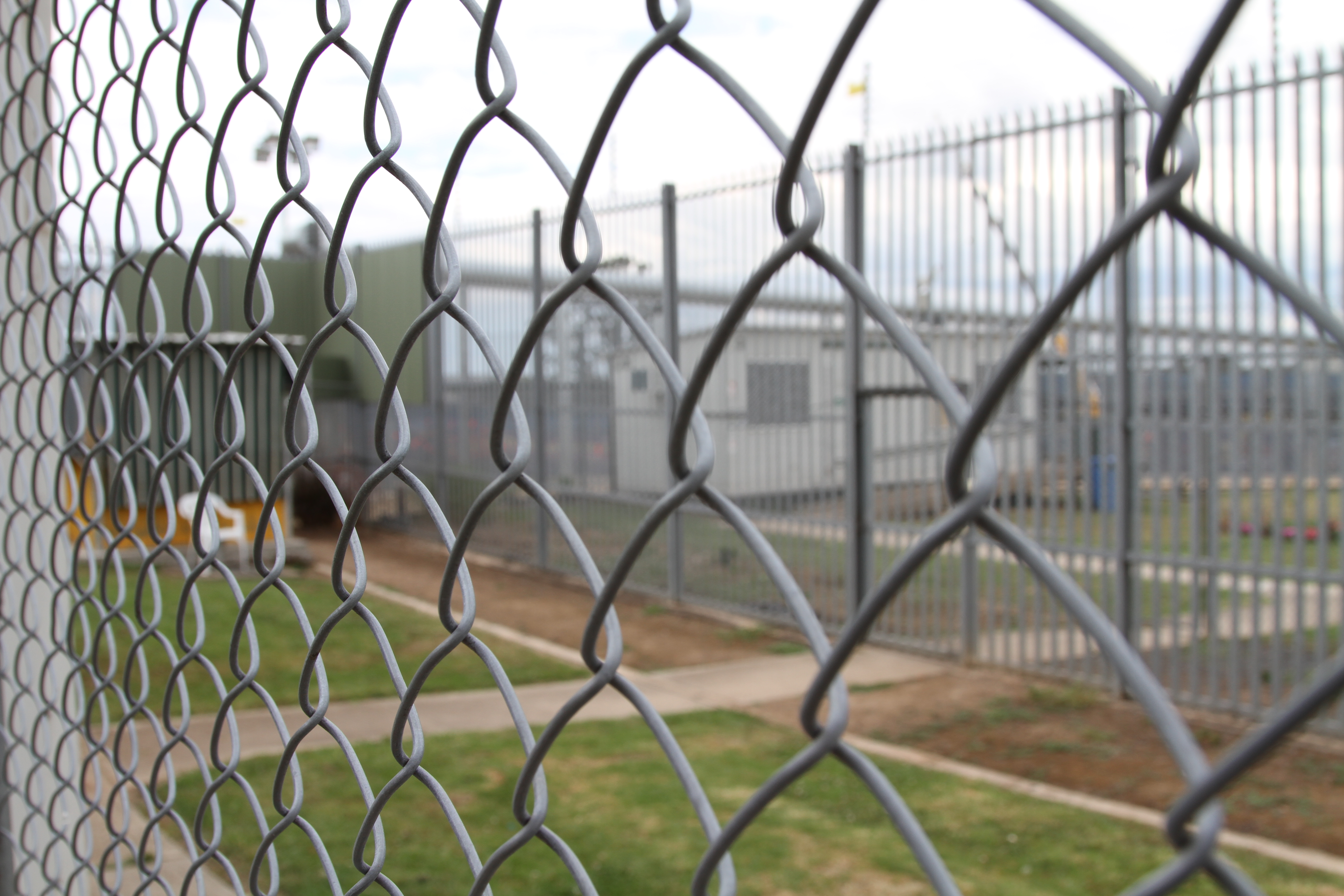
As night falls in Villawood, food containers are hastily packed as visitors say their final goodbyes and exit the mesh of wire and steel.
For those remaining, there is hope that someone, somewhere is listening, hoping, praying.
“We are the silenced ones. People don’t know about us,” Iqbal said.
A copy obtained of Villawood detention centre general manager Susan Noordink’s response to an official complaint made by fasting asylum seekers says standard conditions are being enforced.
“In regards to Ramadan food from the community, Islamic detainees have been advised that all standard conditions of entry will be in force,” Ms Noordink said.
“All community groups must abide by approved visits policy as provided by management and posted in notification in the Gatehouse and the visits area.”
The statement also said arrangements will be made to facilitate prayer areas for asylum seekers.
*Name has been changed at the request of the asylum seeker
I have recently been working on a lengthy investigation with the The Guardian’s Ben Doherty on the continued detention of Egyptian asylum seeker Sayed Abdellatif.
For those who aren’t familiar with the case, Abdellatif and his family attracted national media attention in 2013 when Tony Abbott, then in opposition dubbed him the ‘pool fence’ terrorist and slammed the Labor government of the day for failing to note that a ‘convicted jihadist terrorist was kept for almost 12 months behind a pool fence’.
A Guardian investigation later exonerated him of all violence-related offences, dating back the Mubarak dictatorship era, contradicting claims Abdellatif was a security threat.
I spent hours with Abdellatif and his family inside Villawood detention centre. The family who have been denied the right to apply for an Australian visa, remain in limbo. For the first time they speak about life in detention and reflections on being Australia’s most infamous detainees.
We also reveal new documents which show evidence used to convict Abdellatif in an Egyptian military court – the basis for his indefinite detention in Australia – was obtained by torture.
Revealed: indefinite detention of asylum seeker is based on conviction secured by torture
Exclusive: Sayed Abdellatif faces a lifetime of indefinite detention in Australia because of an adverse Asio assessment relying on evidence from an Egyptian court which documents show was obtained by torture
BY SARAH MALIK AND BEN DOHERTY
Evidence used to convict asylum seeker Sayed Abdellatif in an Egyptian military court – the basis for his indefinite detention in Australia – was obtained by torture, court documents state.
The Egyptian father of six, falsely convicted in absentia of murder in a mass show trial that has since been discredited in his home country, remains in indefinite secure detention in Australia, despite the inspector general of intelligence and security finding he was not a threat to national security.
The three most serious convictions against him were found to be false, and entirely discarded by Interpol, following a Guardian Australia investigation two years ago.
Now, court documents state torture, including by electric shock, was used to gather false admissions on other charges against him.
Abdellatif’s own father, forced to give evidence against his son more than a decade ago, has sworn before a Cairo court “my words regarding my son… are incorrect and were said due [to] compulsion and torture by investigating authorities”.
Despite the new information, 44-year-old Abdellatif faces a lifetime of indefinite detention in Australia without charge or the prospect of release and sees only “a dark future”.
“I will be ignored for years … they used my life and my family’s life as a game,” he told Guardian Australia.
In his first interview from inside detention, Abdellatif spoke of the difficulties of being separated from his wife and children inside Sydney’s Villawood centre where they are all held.
His six children, who must wear security wrist-bands to see their father, only want to lead normal lives, he says, lives where they don’t have to walk to school flanked by security guards.
“We don’t see Dad except on weekends,” one of his daughters said. “We don’t sit as a family, I don’t remember the last time we had a proper meal together.”
The Australian government has found Abdellatif and his family have a prima facie legitimate claim to refugee status, but the Egyptian convictions have caused his asylum case to stall.
Abdellatif was convicted in 1999 in a mass trial of 107 men in Cairo military court.
The trial was widely condemned, by Amnesty, Human Rights Watch and others, as a political show trial, that relied on evidence obtained under torture, and was contrived to marginalise Islamist political opposition to the Mubarak regime.
In absentia, Abdellatif was convicted of premeditated murder, firearms possession, property destruction, membership of a terrorist group, and document forgery.
In 2013, a Guardian Australia investigation into Abdellatif’s trial showed there was no mention of murder, weapons, or property destruction at his trial.
The investigation resulted in Interpol dropping all convictions for violence against Abdellatif.
Abdellatif’s original 1999 conviction relies on the evidence of five men also accused in the same mass trial (one of whom has since been hanged), an Egyptian army officer, and Abdellatif’s father. The evidence presented to the court alleges Abdellatif was a member of a terror network, Egyptian Islamic Jihad, that attended meetings of the group, and helped illicitly move money to members.
Abdellatif has consistently denied the allegations. He told Guardian Australia: “I have never been a member of any group. The Egyptian government [under Mubarak] used to falsely paste this charge to any person they want to punish or to get rid of.”
Now, 2013 court documents – obtained by Guardian Australia, and that have also been provided to the Australian authorities – state that the admissions used to convict Abdellatif, including testimony from his father and brother-in-law, were obtained under torture.
The documents have been verified by authorities in Cairo.
The 1999 court documents state that Abdellatif’s father, Ahmed, told investigators his son had occasionally sent him money, usually in the hundreds of dollars, to be deposited in certain accounts, and that his son “belongs to a religious group but [his father] did not know the name of the group”.
However, a testified declaration signed by Abdellatif’s father states: “I declare that all of what has been said as my words regarding my son… are incorrect and were said due [to] compulsion and torture by investigating authorities”.
Abdellatif’s brother-in-law, Essam Abdel Tawwab, a co-accused in the 1999 trial, gave evidence then that Abdellatif was a member of Egyptian Islamic Jihad.
But in 2013, he told the ministry of justice in a signed affidavit: “I … declare that all the statements that were attributed to me in the public prosecution … especially the statements that mention Sayed Ahmed Abdelmaksoud Abdellatif were written from the Security book and dictated by the Deputy Public Prosecutor. I objected to the statements and I denied them. I was subjected to torture and electrocution in order to sign the paper.”
Affidavits submitted to the Egyptian supreme military court from two more of the co-accused who gave evidence against Abdellatif state: “their confessions in this case were the result of severe torture and physical and moral compulsion that they were subjected to by the dissolved State Security Apparatus”.
The State Security Investigations Service, the principal domestic security and intelligence agency of the Mubarak regime, and which conducted the investigation, was dissolved in 2011, after evidence emerged it was involved in “extraordinary rendition”, and tools of torture and secret cells were uncovered at its headquarters.
In a 2012 re-trial of seven of the convicted men, Egypt’s supreme military court ruled on the evidence presented in the mass trial of the 107: “the claims and accusations against those accused are surrounded by thick layers of doubt and suspicion that weakens the evidence derived therefrom”. All seven were acquitted.
An Interpol red notice on Abdellatif’s name still exists. It now lists convictions for “membership in a terrorist group” and “providing forged travel documents”, charges Abdellatif strenuously denies.
The terror conviction relates to allegations that Abdellatif was an operative of Egyptian Islamic Jihad, of which he said “I have never been a member”.
His only other purported “link” with terrorism was his employment by the Albanian branch of the Revival of Islamic Heritage Society. This was mentioned at his 1999 trial, but was not part of his conviction.
Abdellatif left RIHS, an multi-national Islamic civil society organisation, in 1996.
Six years later, in 2002 – and three years after Abdellatif’s convictions in Cairo – the Pakistan and Afghanistan branches of RIHS were proscribed by the United Nations after they were infiltrated by al-Qaida.
Those branches alone remain outlawed. The UN’s Consolidated List of wanted terrorists and terror organisations states: “Only the Pakistan and Afghanistan offices of this entity are designated”.
However, in 2008, the US government banned the organisation worldwide, alleging it “used charity and humanitarian assistance as cover to fund terrorist activity”.
Abdellatif claims, while he worked at RIHS, the Albanian branch was “clear” and he never had any involvement in organising or funding terrorism.
“It was a charity organisation. We were building mosques, supporting adoption.”
Abdellatif’s employment by RIHS has never been part of any conviction against him. No authorities have ever alleged his involvement with RIHS was improper, or linked to any terrorist activities.
Abdellatif also denies the final Interpol conviction: providing forged travel documents.
A report last year by Australia’s inspector general of intelligence and security found Abdellatif did not attempt to conceal, or lie about, his identity to Australian authorities at any time.
Abdellatif has provided the Egyptian court documents, and translations, to Australian authorities.
The Australian federal police said its inquiries were simply “to ascertain the identity of Mr Abdellatif”.
“The information contained in the Interpol Red Notice and any investigation into these allegations is a matter for the Egyptian authorities.”
The AFP directed all other inquiries on Abdellatif to the Australian Security Intelligence Organisation. Asio, however, refused to answer questions, saying it “does not comment on individuals or investigations”.
However, a source with knowledge of the case confirmed Abdellatif remains the subject of an “adverse” security assessment by Asio, despite the withdrawal of all convictions for violence against him, and significant concerns over the fairness of his trial on other charges.
Abdellatif’s wife and children have been refused protection visas but told by immigration they can live in the community. They declined, saying they did not want to be separated from their husband and father.
From his detention compound in Villawood, Abdellatif told Guardian Australia he had been honest with Australian authorities “but they cheated me”.
He said Australian Federal Police did not reveal to him the details of the initial “red notice”, and he was not told of the false convictions against him.
“The first time I became aware [of the charges] was from the media. I was shocked.
“During the interview with AFP I told them everything, but they hid everything from me. They didn’t tell me anything. I didn’t know why I was put at extreme level of risk.”
Abdellatif says he has lost faith in the Australian government, which he believes is keeping him incarcerated out of embarrassment at its own consistent mishandling of his case.
“They don’t want to say sorry. They want to say ‘we were right and you were wrong’.”
“We are innocent people and we proved our innocence,” Abdellatif says. “I want to prove my innocence to the Australian community because I don’t trust the Australian government.”
The inspector general’s report from last year said Abdellatif was not a threat to national security.
The report also heavily criticised Asio, the AFP and the immigration department for their handling of the case, saying the authorities lacked urgency, withheld information from each other, and made basic errors.

 Sarah Malik