media · violence · war

When tragedy strikes, even onlookers can suffer- as featured in ABC’s The Drum

Here is my latest in ABC’s The Drum “When tragedy strikes, even onlookers can suffer”. The impact of news overload on people’s stress levels was a big talking point, particularly on social media. So many people have messaged me to say the piece has touched on what they too had been thinking about or experiencing.

The piece reflects on my experience as a social media user and as a journalist covering tragic events. I talk more about the inspiration for the piece in this BBC world interview , check me out around the 12 minute mark.

After a week dominated by tragedy and death – and a 24-hour news and social media cycle broadcasting it to us – what impact could this have on our mental health? 

“I have no philosophy, nor piety, no art of reflection, no theory of compensation, to meet things so hideous, so cruel and so mad, they are just … horrible and irremediable to me and I stare at them with angry and almost blighted eyes.” – Henry James

Social media has been a great way to raise awareness and keep journalists accountable...but graphic pictures posted by some has disturbed some users. Picture: Flickr/Johann Larson.
Social media has been a great way to raise awareness and keep journalists accountable…but graphic pictures posted by some has disturbed some users. Picture: Flickr/Johann Larson.

It has been a crazy news week. The second Malaysian Airlines plane crash in five months – the first saw a plane just vanish off the face of the planet and the latter with 36 Aussies among 298 dead after MH17 was shot out of the sky – has seen two unprecedented once-in-a decade news events back-to-back.

You can add to that the alarming death toll in Gaza that has left hundreds dead, a third of them women and children.

The pictures of mangled bodies among plane wreckage and dead children in hospitals dancing on our screens has left many feeling vulnerable and overwhelmed.

The impact of these tragedies on innocent civilians has honed home the transience of life and stirred anger towards those refusing to take responsibility for the carnage.

What has compounded these crises, besides being in close proximity to each other, is our unprecedented 24-hour news and social media cycle.

There are many positives to our new media environment.

It means immediate and constant coverage and a stream of stories that keep us aware of what is happening in the world. It means new voices outside traditional media can make themselves heard.

Journalists and news organisations are now made more accountable as an increasingly savvy audience will call them up on blunders in brutally efficient social media campaigns. The most recent saw NBC journalist Ayman Mohyeldin swiftly reinstated after being withdrawn from Gaza.

But is there a downside to the 24-hour news and social media cycle?

It seems we are caught in a catch-22 situation; the greater appetite for coverage feeds the constant stream of output by media organisations struggling to milk the story of every angle.

But is the constant barrage of information and sometimes graphic content spilling over our screens and personal social media networks having an impact on mental health?

Studies show those exposed to more than six hours of daily coverage of a traumatic news event can suffer more stress than those directly affected.

Melbourne psychologist Monique Toohey says in seeing graphic images an unwanted and intrusive replaying can occur, particularly as people try to unwind and go to sleep.

What you see cannot be unseen. I use this statement with my clients who find themselves replaying horrific images and videos and stories in their mind, hours and days after they were exposed to them in their Facebook or Twitter feeds.

I’ve never seen so many sad people this week. Even hardened journalists looked at me with bleary eyes reporting news fatigue.

Whether it was on your phone, email, Facebook, Twitter, at work or in a social setting, the news was streaming in, often unbidden from all directions.

Most media outlets filter pictures, prefaced with warnings, carefully balancing the news imperatives of showing the gritty reality but also being respectful of the dead.

Some media outlets, including NY Times and the Sydney Morning Herald, featured graphic coverage that was much applauded. I think written accounts occupy a different sphere. It gives you the full impact of the scene without the physicality.

In this coverage it was the small details that gave poignancy and humanised the tragedy, in a way gory blood images could not. Also when a reader clicks on a written story, they have the option of continuing to read or not.

Images, however, cannot be erased. Twitter and most social media outlets expose users in their social spaces, who are not seeking that content. In the case of family members who have not been notified, the results of exposure can be especially tragic. While Facebook and Twitter guidelines implore users to act responsibly, it is largely a self-regulated sphere.

Many of my friends felt disturbed by the graphic pictures of dead Palestinian children in news feeds used as a kind of moral pornography in propaganda fashion – designed to shock and often featuring dated or wrong images that undermined their cause and disrespected the victims. These pictures accompanied by self-righteous ballasts, ironically made from the comfort of a first world living room just fed the often draining debates that have left people feeling more angry and dejected.

I don’t undermine the power of social media to provide solidarity, support and powerful emotional sustenance to those outside the tragedies to vent their anger, frustration and powerlessness and also organise to rally. But I know many people have become paralysed and switched off by the overkill.

Ms Toohey advises those who fear this exposure to protect their online spaces, moderate their activity and post responsibly.

Personal censorship is required and each individual should tune in to their emotions and know when to turn the TV off, scroll quickly past photos before they load and, rather, engage in helpful coping strategies.

By switching off occasionally and having time to reflect it can empower people to help in practical ways.

In covering major news events, what I was always reminded of but could rarely report was people’s grace and courage under the most unspeakable circumstances. Whether it was a murder victims’ family using the death to become activists against drink driving or a community rebuilding after being shattered by bushfire.

The capacity of humans to endure, hope and dream despite it all is what should give us hope. The stories of survival and resilience should inspire us to support those who have the courage to bear what we find difficult to even witness.

war

Checkpoints and clashes: life in the West Bank- as featured in ABC’s The Drum

Here’s my latest for ABC’s The Drum on my recent trip to Jerusalem and the West Bank cities of Hebron and Bethlehem.

Little girl at Deheishe refugee camp near Bethlehem.

It’s easy to feel removed from the continuous coverage of instability and violence in the Middle East.

The never-ending conflict between Israel and Palestine has a depressing predictability that seems to blur into erupting cycles of deadly violence, acrimonious rhetoric and scenes of weeping mothers on both sides, paying the price in this seemingly intractable dispute.

In the latest escalation, the kidnapping and murder of three Israeli teenagers found near Hebron in the West Bank last week sparked widespread calls for revenge, with protestors in Jerusalem chanting “death to Arabs”. A few days later, a Palestinian teen was burned alive in what is believed to be a revenge attack.

Since the June 12 kidnapping Israel has meted out collective punishment on the occupied territories, raiding hundreds of homes and demolishing those of suspected kidnappers, launching airstrikes on Gaza and road-blocking Hebron, as Israeli prime minister Benjamin Netanyahu promised to avenge the deaths.

Much of the media coverage focuses on covering bursts of conflict in a vacuum, with little context or historical analysis. Rarely do you get a picture of daily life on the ground in the territories and the impact of Israeli military presence and settlements in the region.

Hebron market vendor speaks about harassment from settlers who live above Hebron market.

Two months ago I was in Jerusalem and from there visited the two largest Palestinian cities in the West Bank – Hebron and Bethlehem. My entry into the most contested piece of real estate in the world was met with a six-hour detention, where I was questioned and interrogated along with dozens of westerners attempting to enter Israel. We watched two young Palestinian-American men, turned back and banned for five years. One of the boys, a medical student intending to volunteer at a Jerusalem hospital was told he didn’t have required embassy permits to volunteer.

Settlement in Hebron.

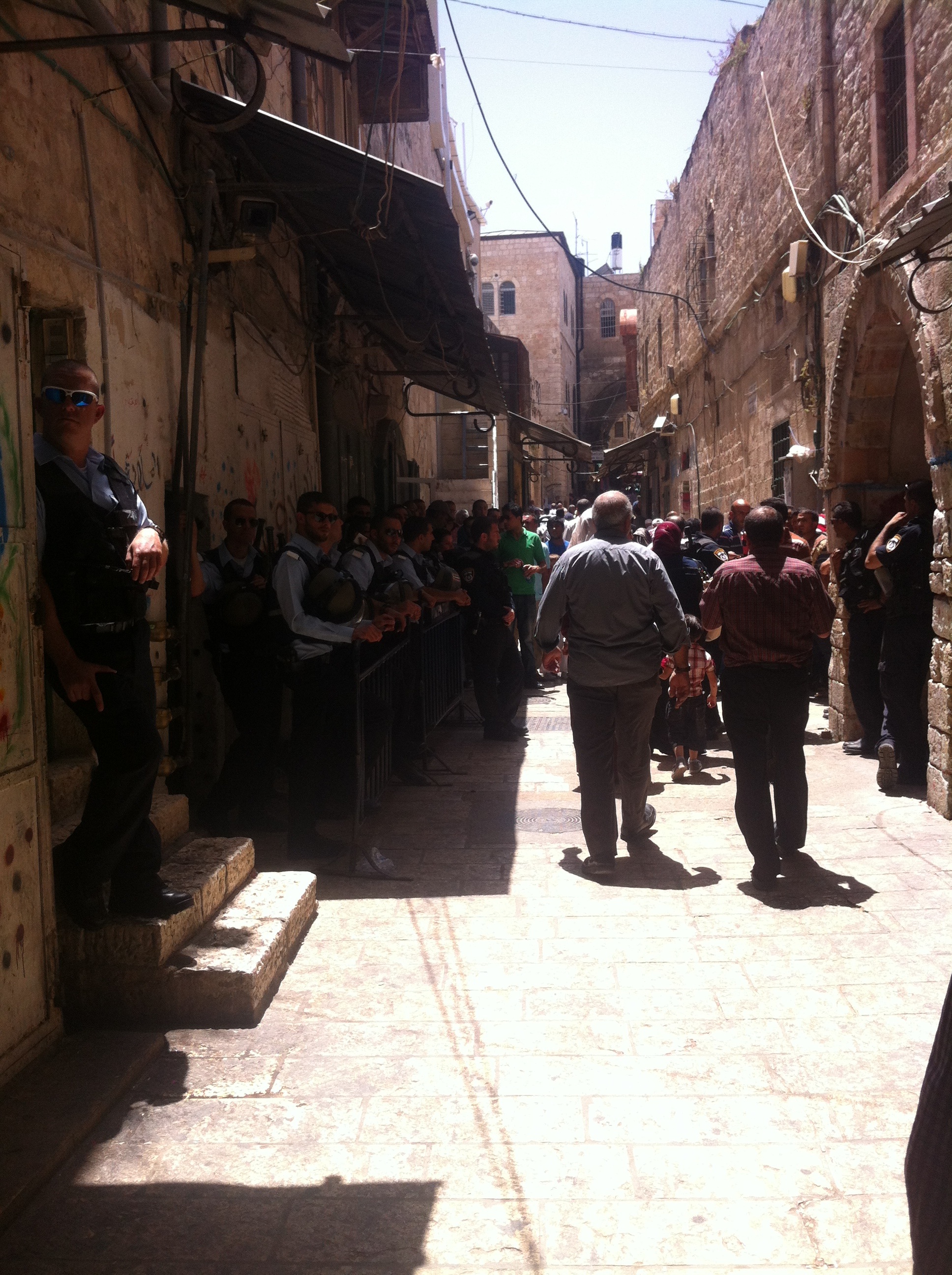
During my stay, I have never seen more machine guns waved in my face or had my passport checked more often in my life. Young IDF soldiers with machine guns casually slung around their shoulders control access to holy sites, including the Dome of the Rock, the third holiest site for Muslims.

Soldiers at Al-Aqsa entry gate at Friday prayer, Jerusalem.

Checkpoints to enter are dotted around the mosque. Along with many Palestinians, I got used to daily questioning as I entered. Sometimes I had to recite Quranic verses to prove I was Muslim, other times I had to show my passport. On Friday, the checkpoints are packed with soldiers and clashes are common as young men are arbitrarily turned away for juma prayer.

In Hebron, where among 160,000 Palestinians, about 700 Jewish settlers live, protected by hundreds of IDF soldiers, a steel mesh dotted with garbage covers an open air Hebron market.

Wire mesh covering Hebron market.

When I asked what it was for, the Arab vendors told me the the mesh protects them from urine, faeces and rubbish thrown down by settlers living above the market.

Rubbish in wire mesh covering Hebron market.

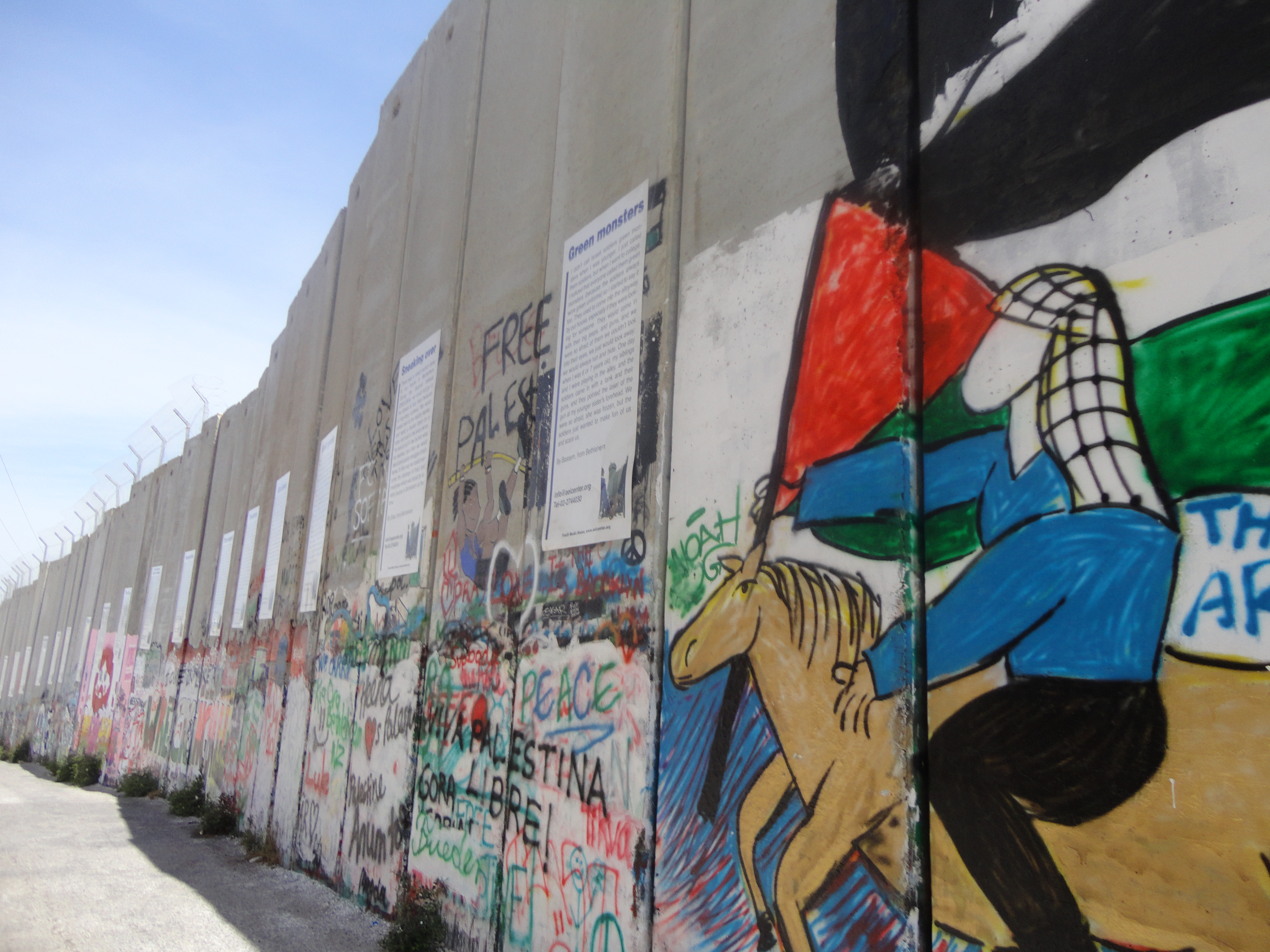
The feeling of being contained continues in Bethlehem as we weaved our way through a confusing array of zones and checkpoints to visit the Separation wall. The massive eight-metre high concrete block, covered in protest graffiti snakes its way through huge sections of Palestinian territory, along with Israeli-only roads and checkpoints that bar Palestinians from Jerusalem.

Separation wall, Bethlehem

In the nearby Deheishe refugee camp, an air of hopelessness pervades the cramped buildings, as aimless children kick soccer balls through the streets in front of walls scrawled with Arabic political graffiti. One mural includes lines from Arab poet Mahmoud Darwish that reads: “The war has taken everything from me. All I have left is my dreams.”

Arabic graffiti at Deheishe refugee camp, near Bethlehem. Lines from Arab poet Mahmoud Darwish which read, “The war has taken everything from me, All I have left is my dreams

Water tanks dot the rooftop landscape to deal with fluctuating supply, as Palestinians are forced to buy back water diverted by Israeli pipes at inflated prices.

The collective fear and paralysis, the brutality of continued occupation breeds among a hopeless Palestinian population, and an increasingly militarised Israel is ultimately crushing to both sides. Continuous settlement and dispossession not only hurts Palestinians but must also create scars on those forced to implement it

I saw this in the scared faces of some the very young IDF soldiers conscripted for mandatory service and the aimless children in the refugee camp bound to grow up as angry teens. As the rhetoric of dehumanisation continues, it’s clear no one feels safe as innocents continue to suffer.

Jordan · media · travel

Jordan reflections

Friends of mine have been curious to know what the people are like here and the political issues (besides the amazing food and stunning natural beauty, see video by my very talented friend The Graphical Baker ^).  I’ve been wary because  I don’t want to make generalisations. So disclaimer- here are some observations based on my limited experience and interactions here.

Money /The Government/Wasda

There’s a huge divide here between those who have means (who live in West Amman) and those that don’t (generally East Amman). It came to a head when the Mercedes- driving son of a minister went on a tirade on facebook about his argument with a Kia driver, raging against the ‘backward xxxxs’ in Jordan. A local I met recently, Ali*, told me this was particularly galling because most people in Amman drive cheap Kia cars. Everything is expensive here, due to import taxes. I was flabbergasted to see a toaster with a tag of 25 JD ($AUS37) at the local shopping centre. I’m told the minimum wage with tips will get you around 250 JD a month, which is roughly half the weekly rent for a roomy apartment in central Amman. High employment combined with the rising cost of living and the perception of widespread nepotism and corruption has created a powder keg of discontent.

For young middle-class educated Jordanians, the aspiration seems to be to go abroad. Ali, a languages student who speaks Russian and Spanish, wants to work as a diplomat but says nepotism means plum postings are generally reserved for the connected elite. There’s even a term for it: ‘wasda’.

Rabia*, a young teaching student at Jordan university, says it’s so bad you’ll have guys who will not turn up to class all semester, but will show up at the end to  be ‘passed’. I asked how that works for professions where you could actually kill someone, and she said in med school you have some professors who will tell the class straight up, there’s no ‘wasda’ here, so don’t even try.

While Jordanians I spoke to are not entirely happy with the status quo, they are grateful for stability and safety in a region where Jordan seems to be the only safe harbour. They are wary of the unrest revolution in nearby countries has created. One of my teachers said that whilst we’re not entirely happy, we don’t know what the alternative would be. Ali says Jordanians don’t want a revolution but they want change. Any discussion of the ruling Royal family is done in hushed tones and in private.

Palestine

In a country where most people are of Palestinian background, the conflict with Israel is central. It’s the recurring issue in personal stories and in the news. Pretty much everyone has a story of being denied entry into Israel (especially young men), of a grandparent losing everything and migrating but dreaming of being able to visit again. Many won’t recognize Israel as a country and say Palestine instead. There’s a perception that US is not an unbiased mediator. It’s the cause of a lot of anger and disbelief and there is pessimism there will ever be a real solution to the conflict.

Refugees

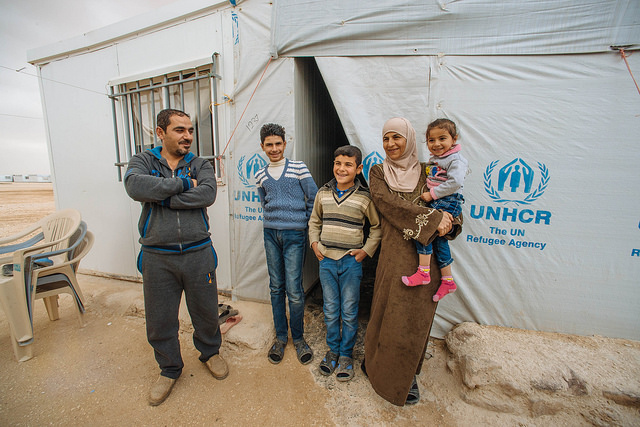
Syrian refugees at the Zaatari refugee camp in Jordan. Picture: UNHCR/ Jared Kohler
Syrian refugees at the Zaatari refugee camp in Jordan. Picture: UNHCR/ Jared Kohler, Flickr

A lot of NGO workers I’ve met here are working on building camp infrastructure for the thousands of Syrian refugees flooding in over the border. A conversation between two Jordanians I met reminded me of the debate around asylum seekers in Australia.

A: It’s costing us a lot of money.

M: The UN is paying for everything. I’m really worried about the camps. I heard people are dying there.

A: The problem is people coming here without passports and papers. You can’t have open borders.

A: I feel sorry for them. They’re fleeing for their lives, they might not all have papers.

M: Also Syrians are willing to work for less than Jordanians creating problems for locals.

A: They contribute. I feel sorry for them.

M: So do I. I hate the situation not the people.

The difference of course is that M has loads of Syrian friends and a great deal of sympathy for the plight of those fleeing, generally reflected in the public mood towards refugees with numerous fundraisers and events dedicated to Syria (in Australia, the right-wing view features mostly hatred, hysteria and racism). I think the fact that Syrians, like Jordanians, are Arab Muslims, probably makes a big difference.

Gender/Religion

Jordan is generally a conservative country but I think liberal by standards in the region. A local tour I went on (where we were the only foreigners) and a group of artsy liberal Jordanian students I met recently seemed like hanging out with a group of 20-somethings back in Australia, down to justifying my abstention from alcohol (which is freely available). The men love to dance, openly hug and kiss each other and seem really to know how to have a good time (that was just on the tour bus). Most women wear hijabs with fashionable western clothing but many don’t. You can walk around safely pretty much anytime of the day or night, and will not be bothered except for the occasional hooligan, though I have heard of foreign looking women being hassled. Like Pakistan it feels like you have a divide between two groups -those who are liberal and irreligious, mix freely and party and those who are religious and conservative. But I think there is hope for that rare breed- the religious liberal – bucking tradition but staying true to their Islamic roots. One of my teachers is a single hijabi and practicing Muslim who works, lives out of home and travels abroad despite societal and family disapproval.  It will be interesting to see if it is people like this, who can successfully reconcile tradition and modernity within themselves, can pave a navigation of those forces within society.

*Names have been changed.

Uncategorized

Review: Coming of Age- Growing up Muslim in Australia

Check out my latest review in Sultana’s Dream of  Coming of age: Growing up Muslim in Australia. If you haven’t already make sure you have a read, there’s something here to relate to regardless of whether you’re Muslim or not. The anthology features awesome Australian writers including Randa Abdel Fattah, Tasneem Chopra and Amal Awad whose personal stories will make you think and reminisce about your own awkward adolescence.

Coming of Age: Growing up Muslim in Australia is published by Allen and Unwin.

Gloria Steinem once said that “every social justice movement that I know of started with people telling their life stories.”

The same could be said for understanding the reality of multicultural Australia; those stories that are rarely reflected in the whitewashed beaches of soapie suburbia.

Growing up not-white and Muslim in Australia means becoming inured to a media and popular culture reflecting back faces and worlds which bear little resemblance to an everyday reality punctuated with ritual, some kind of after-school class, parental expectations and confusion.

In this context, Coming of Age: Growing up Muslim in Australia is a welcome balm, like looking into a too-close mirror, familiar but also unnerving. The anthology features 12 Muslim writers sharing stories of migration and dislocation, navigating two worlds and cultures and grappling with familiar adolescent pangs around sexuality, love, body image, faith and identity.

The vignettes in Coming of Age chronicle the experiences of this first generation children of migrants, navigating a place within Australian culture as the culture itself navigates how to accommodate a fusion at once deeply familiar and different. Hybrids sporting ocker credentials like Indian-Kenyan activist Tasneem Chopra; growing up in country Victoria amid bush dancing and yabby-catching while going home to practice Indian-dance, later showcased wearing glittering bangles at YMCA halls.

The anthology features familiar names including children’s author Randa Abdel-Fattah, footballer Hazem El Masri and his wife Arwa El Masri, lawyer Irfan Yusuf and writer Amal Awad, but also dispersed are valuable contributions reflecting the diversity and complexity of Muslim communities. From self-confessed ‘mish-mash’ Muslim and former Miss World Sabrina Houssami to devout, agnostic and atheist voices from a rich diversity of sectarian and cultural backgrounds, the book is a learning experience even for those from within the tradition.

Pakistani woman Alyena Mohummadally shares the trauma of coming out to her Muslim family and reconciling faith with her sexuality. There are moments of unconscious levity in even the most gut-wrenching scenes. Mohummadally’s mother confronts her, not after previous less-than-subtle intimations about her sexuality from her daughter but only when Mohummadally brings home the women’s cricket team for a sleepover: ‘I have always attributed my mother’s question to her being aware of the stereotype that women cricketers and the queer world go together,’ she recounts.

Racial-slurs and schoolyard taunts are explored in the same breath as cringing teen crushes and moments of parental embarrassment. Headshots of the writers as gangly adolescents bring back memories of adolescence as life’s universal awkward hour, but exacerbated by the self-consciousness of ethnic difference.

Psychiatrist Tanveer Ahmed remembers being inundated with kilos of pungent seafood in the car after his triumphant father spends an afternoon bargaining with vendors at Sydney’s Flemington markets. Yusuf recounts ‘the phone call day’ every desi kid dreads. The day HSC marks are released and the phone rings off the hook as ‘Aunties’ interrogate parents on the life plans and marks of their progeny.

Former Bulldogs legend El-Masri and academic Michael Mohammad Ahmad, both of Lebanese background reflect on the burden on Muslim men post-September 11, as the description of ‘Middle eastern appearance’ becomes an epithet of suspicion. There are lessons from their own youth dodging the temptations of drugs and violence as they minister to troubled youth.

In an age still full of caricatures and shrieking headlines, this anthology is a long-overdue offering. Stories of young people, now well-known adults who by sharing funny, human stories of their youthful frailties, relationships and loneliness are in turn changing our cultural landscape and what it means to grow up Muslim in today’s Australia.

Coming of Age: Growing up Muslim in Australia is published by Allen and Unwin.

Amman · Jordan · travel

Guide to taxis in Jordan

Hospitality workers and taxi drivers have a heavy burden to carry. Not only are they professions where long hours equate with low pay, they also become the default cultural ambassadors of any country.

The intersection between taxi drivers, generally working class folk (though I’ve met drivers who are struggling grad students) and generally privileged travellers is a fascinating study in itself (some might contest ‘privileged’ but even if you’re a poor traveller, by virtue of being able to choose to be away from your western home country you are privileged imo).

Generally taxi drivers here have been pretty friendly and helpful, with my mishmash of Arabic we can figure out where to go. Things are bit more, shall we say, laissez faire here. Be prepared for lots of chain smoking (Mad Men prevalent here), talkback morning radio and the driver stopping for a roadside coffee pick up or even to say hi to a friend. The smoking carries on in cafes, restaurants and in most public spaces (which makes the incessant warnings not to smoke on the plane on my way to Amman finally make sense).


Catching taxis in Amman is a precarious business. Picture: Paul Keller, Flickr
Catching taxis in Amman is a precarious business. Picture: Paul Keller, Flickr.

The fastest way to get around is a taxi which is relatively affordable, safe and in plentiful supply (at least in non peak hour times). Knowing enough Arabic phrases to get around is a must. Street addresses won’t cut it here, so best to know a landmark around where you’re going.  Drivers are nothing if not resourceful and will stop locals or even call a friend to find a tricky destination with limited information.

Catching a taxi is a great way to practice street Arabic, understand local culture and get the best tips on restaurants (though there is no obligation to make conversation if you’re a female, or if you are uncomfortable with any personal questions). I’ve heard grumblings about economy and cost of living, and gained insights into social interactions.

Dealing with drivers is also the best way to do to your head in trying to control what I will delicately call the ‘the meter situation’.

The battle of the meter begins when you step in. You need to make sure it is set to 25 qirsh or a quarter of a dinar. A trip anywhere in Amman should cost no more than three to four JD.

Every traveller and even locals have taxi war stories to tell. Some drivers won’t turn on the meter and will want to negotiate a price and then maybe ramp it up later. Some travellers ruefully admit to being charged up to 10 and even 20 JD.

After 11pm the fare will generally double and the meter will start from a higher base. Yellow taxis are your best bet. You can venture into the shared white taxis which are cheaper (you shouldn’t pay more than a dinar) but prepared to share with other passengers.

Now if I were poor taxi driver I would try to extort as much as I can too. But being on the other side of the driver’s seat (and if you’re a woman it’s culturally most appropriate to ride in the back) I’m here to provide practical tips to avoid being ripped off.

Besides refusing to ride into a non-metered taxi, there are some beautiful Arabic phrases to deal with tricky taxi or market negotiations. My favourite idiom “fi mish mish”  (which means something like “in the apricot/s”) translates delightfully to convey the ridiculousness of a proposition; an Arabic “when pigs fly” if you will. This is all part of the drama of bargaining in countries where respect derives from your ability to Apricot the situation.

The way you negotiate living in a city is I feel almost a microcosm of a society’s values. In western countries most commercial transactions are passive, fixed, cold. In others, everything is a negotiation, a dance, a play between two people where one’s knowledge and wits can be tested. This can be stressful when you’re used to the latter way of doing things, but once you understand how it works it can be enjoyable.

If all else fails just remember throw up your hands Arab style and shout,  “In the Apricots!”