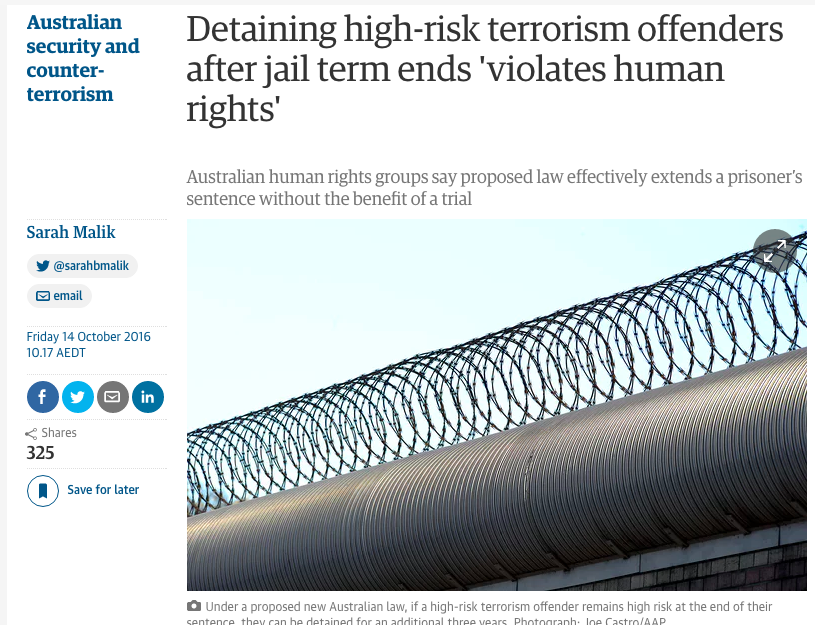
Australian human rights groups have raised concerns over a proposed government bill that would allow for the continued detention of “high-risk terrorist” offenders at the end of their sentence.
Under the government’s proposal, a state or territory supreme court will decide if a high-risk offender remains high risk at the end of their sentence.
For a high-risk prisoner to be kept in jail, the court must be satisfied that no other less restrictive measure would be effective in preventing “unacceptable risk” to community safety.
The maximum period for which a continuing detention order can be made is three years and the person must not be detained in the same area as the general prison population .
Human rights groups will present their submissions to an inquiry into the proposed criminal code amendment (high risk terrorist offenders) bill 2016 during hearings in Canberra on Friday.
In one of the written submissions, Prof Ben Saul, Challis chair of international law at the University of Sydney said the scheme violates Australia’s international human rights obligations by characterising continued incarceration as preventative detention.
“Prisons are built for prisoners, not non-prisoners … I am not aware of prison facilities where a person subject to a continuing detention order could be meaningfully separated from, and treated differently than, prisoners,” he said in his statement.
Human Rights Watch said in its submission there was ambiguity around what constituted “high risk”. Terrorism legislation provides for up to 15 years imprisonment for non-violent offences including possessing a “thing”, providing material and resources, or having membership related to a terrorist group.
“Australian law’s overly broad definition of terrorism makes the bill particularly worrisome,” the group said in their submission.
Human Rights Watch said existing laws already provided for control orders that allowed tracking and surveillance of suspects.
The Muslim Legal Network said in its submission the proposed scheme breached human rights obligations by providing for potentially indefinite, arbitrary and punitively retroactive punishment.
Zaahir Edries, president of the Muslim Legal Network, said the measures effectively added a criminal sanction to a prisoner’s sentence without the benefit of a trial.
“Proposing this kind of legislation where there are minimal safeguards and the standards are lowered to prove them poses a dangerous and unacceptable infringement on civil liberties,” he said.
The Lebanese Muslim Association’s submission said the government’s proposed measures were counterproductive and risked creating “martyrs” out of those incarcerated while further alienating Muslim youth.
The office of the attorney general, George Brandis, has been contacted for comment.
I love the beach. I live right near one and as the weather warms up, there is nothing more glorious than walking the golden shores and sinking into the cool water. But it hasn’t always been a comfortable fit. The beach always seemed to be a white people place, like the fictional Home and Away, filled with chiselled blonde bodies, far away from Sydney’s western suburbs where I grew up.
I remember awkward outings as a kid to the coast with waddling Aunties in voluminous shalwar kameez who would lift their loose shalwar to dip a foot in the water before running away to eat pakoras. We ethnics were no good at water things and especially for girls, it was never encouraged. On the other side of the equation, hairless bikini babes only please.
When the Cronulla riots broke out in Australia in 2005 it seemed to confirm the metaphor of the beach as a kind of cultural battleground welcome only to a certain kind of person; the last glorious Anglo frontier against the dreaded Muslims. The riots have been endlessly analysed through the lens of race, with gender in the background. Most of the rioters were young white men going mad in a kind of macho posturing over women and property centred around protecting “our things” (white women, beach) from “them” (the not white, strangely clad interlopers). This in itself reflected a problematic male entitlement that gets to dictate the norms and responds with violence at perceived infringements of power.
Then the ‘burqini’ came along. The burqini was an ingenious Australian invention that facilitated swimming for conservative women who observe Muslim modesty guidelines. Some of my good friends are burqini babes. They are lawyers and academics, mums and corporate executives, some are even swimming instructors.
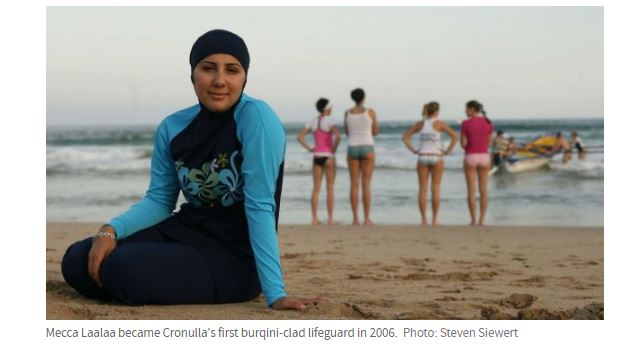
In 2006, Mecca Laalaa became the first burqini-clad Muslim woman in Australia to become a lifeguard, trailblazing a road for Muslim women to not only participate but own the surf. It reminds me of the last scene in Puberty Blues, a coming of age story of teen girls set in the 1970’s Sydney Shire, when the girls decide to go from being spectator eye candy to grabbing surf boards and diving into the ocean against cries of the astonished boys yelling “chicks don’t surf”.
And it’s not just Muslim women who want to surf in these suits – the exquisite Nigella Lawson once famously sported a burqini for sun protection. For those who want to remain fair and lovely or don’t feel comfortable with the body beautiful display otherwise required on the beach, various forms of the suit gives freedom to frolic with joyous abandon. All good right? Wrong.
A swimsuit that encourages those of all shapes, sizes and backgrounds to participate, have agency and be physically active and comfortable should be a win for all women right? Wrong again.
In France, anyway. The French mayor of Corsica has reportedly become the third in the country to announce a ban on burqinis, following weekend clashes fuelled by a row over the outfit, sparked by a man incensed over a photo taken of one of his party – a burqini clad woman.
The oddly named French Women’s Rights Minister failed to oppose the move, having previously spoken against the “archaic” garment. Now these women who were perhaps even braving the disapproval of the more conservative in their own community will be back to watching from the shoreline. They will be exactly where the right wing French and Muslim fundamentalists like them to be, on the sidelines – all in the name of their freedom and dignity of course.
I’m sure the ban will be a liberating experience for the Minister; because banning things and policing a woman’s access to the public space is always a great celebration of freedom and a good answer to male violence. Vive la France!
Once again, it is women who pay the price and are the pawns used in the cultural battleground between knuckleheaded men and the wider violence of a male dominated state apparatus. An apparatus that echoes the values of those in power, with the faint whiff of former European colonial overlords straining to accord equal status to the subjects they once ruled over.
The message is clear; your belonging here is conditional, engage only our terms or not at all.
The ban is an attack on minority communities, already subject to increased surveillance and harassment, who occupy the very bottom of the social hierarchy; and its most vulnerable members – Muslim women.
Women who not only have to navigate sexism within their communities, but also the brute force of state authorities intent on crushing their autonomy – and rendering the men in their lives humiliated and impotent against these incursions. All for ‘freedom’, in the most Orwellian sense of the word.
It’s been ten years since I visited Pakistan, the place of my parents’ birth. My most vivid memory from my last trip to Karachi, nestled off the southern coast of the country, was going to a beauty ‘parlour’ for a facial.
As the beautician lathered the mixture on my cheeks, a sharp, stinging sensation burned across my skin. I began to yell, desperately clawing the foam off my face.
The beautician looked at me surprised.
“The facial is laced with bleach to, you know… clean up your face,” she said gesturing to my unacceptably brown skin.
“She’s from outside,” someone would finally say in these moments, taking in the bottled water and hand sanitiser clutched in my hand.
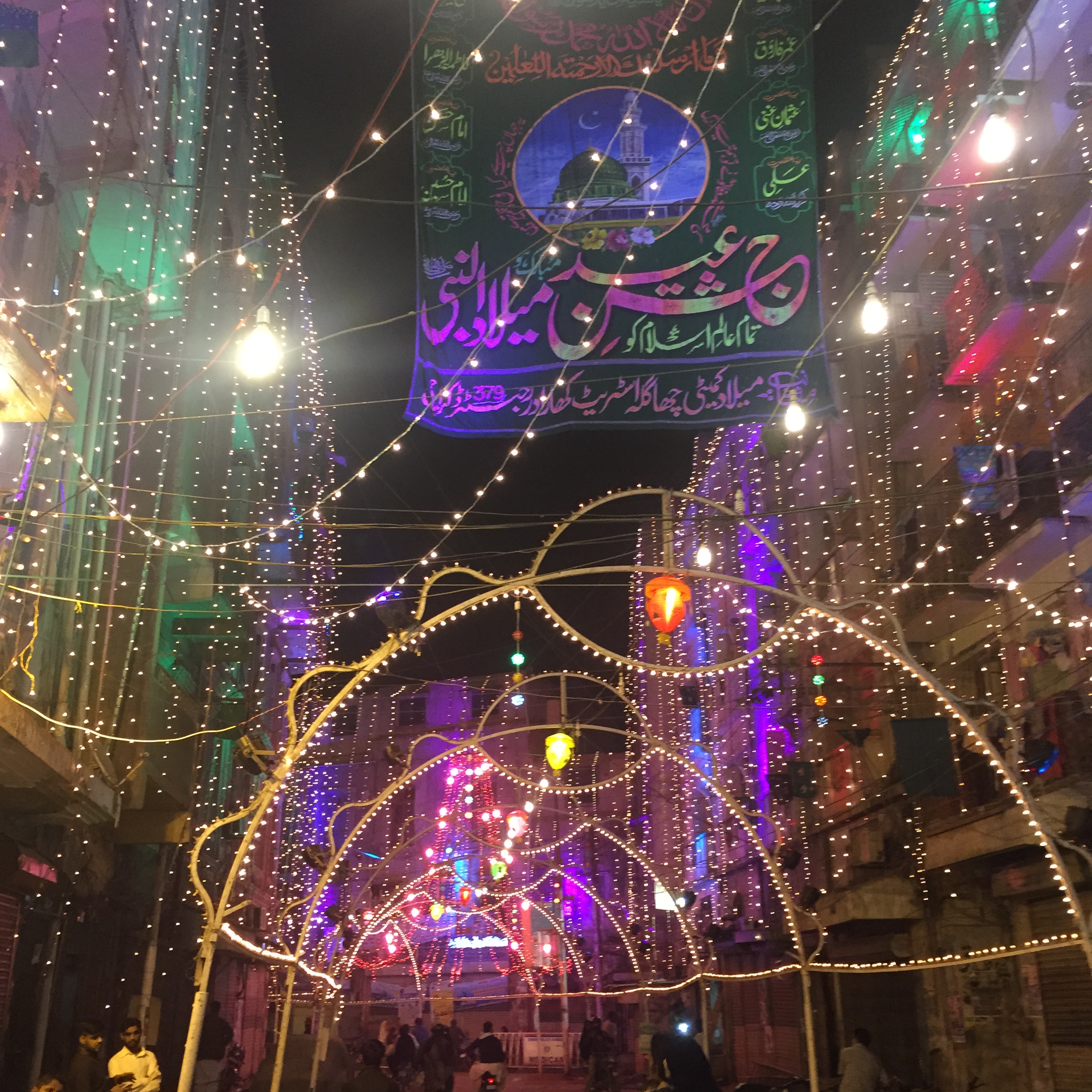
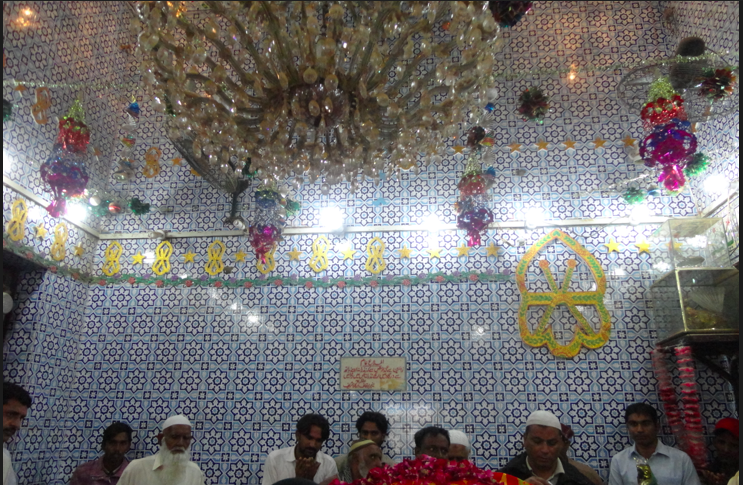
Karachi lit up at night for the Prophet’s birthday on the 12th day of Rabi’ul Awaal.
Confused eyes would register recognition, my faux pas dismissed with indulgent smiles.
Getting your face nearly burned off is only one of the many challenges of being a child of diaspora migrants returning to the homeland. But there are also moments of recognition and familiarity.
It’s a strange experience walking in a street where everyone looks like you. Navigating a foreign city where I can slip in quietly and understand some of its contours is like being in a dark cinema.
I’m incognito, an observer of the world unfolding in front of me, uncontaminated by my intrusion. I get a front row seat into a world from where I have inherited a language, skin colour and culture.
Abdullah Shah Ghazi shrine in Karachi.
Finally I understand things about family that confused me. Like the need to cover everything in plastic (it is very dusty in Pakistan); the inability of middle-aged desi women to dress for winter and their strange obsession with shawls (it never gets cold here). There’s also the staunch refusal to abide by airport luggage rules or pay full price for anything (fixed prices are always negotiable).
Most profoundly there is a renewed respect for my parents and their ability to forge a completely new reality for themselves, giving me privileges that prove both a blessing and a gulf, catapulting me into worlds they could never access.
My fluent but careful Urdu feels like a metaphor for my in-between status with this ever-present gap between what I can say and what I want to say.
I feel, as always, still an interloper, like a new guest at a party where everyone knows each other and speaks in references you could never fully understand.
To be a liberal in Karachi means being critical of a society where authoritarian power structures and radical social inequalities fuse together with right-wing religious politics, at polar ends to the spiritual soul of South Asian culture represented by slain Sufi singer Amjad Sabri.
It is a city of Adhans and jostling rickshaws, slums and celebrities where nothing works but everything can be arranged. A city where brides with red lips promising eternity, hands adorned with dark henna, step over potholes in stilettos into festooned halls, defying the latest western headlines shrieking the country has collapsed.
There’s something cheerful and irrepressible about these shaadi halls that dot the broken landscape of Karachi like gaudy baubles. The neon lights winking at you, advertising themselves for sale in a city always ready for business, to make a deal as swiftly as arrange a marriage.
With all the drama and chaos of the news, there’s a relentless energy that pulsates through the streets. A no-nonsense co-operative hive that comes with 20 million people crushed together into a forced self-sufficiency.
Drivers jump out of rickshaws to haul broken carts to clear roads.
Shopkeepers raise their eyebrows in the dance of bazaar negotiations offering you chai and a chat, a commercial deal peppered with personal interrogation. Plumes of cigarette and engine smoke link everyone together in a cloud of familial dysfunction; praying, living, surviving.
It’s different here in Australia. To be liberal in a western context for a child of diaspora migrants means asserting a re-interpreted but proud minority and faith identity, sometimes in the face of powerful forces keen to frame difference, especially of the Muslim variety, with danger. It’s a more colourful mosaic, so fragile and easily shattered by wounding words.
The degree is vastly different, but in each society the demagogues are the same. They share the same rejectionist, exclusionary worldview, they want you to be afraid of what appears different.
They tell you the woman selling chai and you are different. The man frying jalebis puffing up like golden swirls in his vat, to get his daughter a seat on a golden throne in one of those shiny shaadi halls, is different from you.
For them there is no fusion; only binary. It is us and them. But they are you. They are me. Western and Australian and Muslim and Pakistani and all fused together so that we don’t know anymore where I start and you begin.
As debates rage around race, religion, Islam and multiculturalism in a climate of global insecurity and right-wing zealotry, we engage because these words are not just platitudes but a lived reality borne of struggle and survival.
They are the smell of coconut oil on supple skin and hands worn down from kneading dough during night shifts at restaurants. They are dreams of that white collar job, shattered by a callous remark; of once friendly eyes darkened with suspicion.
For all of us in that in-between space, forced to declare allegiances or endure a trial by bleach, perhaps you don’t need to always feel aligned with your environment or even your world. There is beauty in fusion and contradiction; this confusion can be creative and critical.
Sometimes in the frustrating gaps there is a space, as fragile as a flower, to create, to dance on that tightrope of difference and embrace the exquisite tension it inspires.
Criticism is sometimes taken as disloyalty. But to criticise is not to fault, but to be passionately invested in the evolution of what you are criticising. It is to feel your stake in it with a kind of blinding ferocity that leaves you breathless.
In the rush of tangled emotions still swirling as I said goodbye to Karachi, I won’t forget the flooding relief that hit me hard in the heart as soon as I stepped into Sydney: I’m home.
I can’t stop thinking about Qandeel Baloch – the social media celebrity murdered by her brother in Pakistan in a so-called honour killing last week.
Qandeel is me. Qandeel is every woman I’ve met who worries about reactions to that sleeveless shirt Facebook picture or who faces narky comments on whether her hijab is too revealing. Her murder is an extreme version of the constant policing women everywhere face on their clothes, bodies and relationships which settles on the skin like a fine mist of shame, turning you inward, self censoring. Famous Muslim men like Muhammad Ali and Imran Khan are feted by scholars despite past indiscretions. Their sexuality never defines them in the same way it does for women, for whom punishment is swift for any aberration from moral norms.
.
Qandeel Baloch. Picture: Twitter @QandeelQuebee
Qandeel was working class and sexy and gauche and fabulous and wanted to be famous. The fact that any of those things is a qualifier in expressing sadness over her death, as seen in online reactions, is frankly terrifying to me. Twitter activist Mehlab Jameel links to a Facebook comment by Fauzia Kasuri, a supposed women’s rights activist in Pakistan who writes: “Whatever Qandeel Balouch did…it was wrong…but her brutal death shouldn’t have been her fate.”
The modern, popular culture, exhibitionist, selfie-style of female brazenness does not sit well with suffragette-style Muslim feminism which seeks greater freedoms without disturbing social norms. But women like Qandeel are no less deserving of our sympathy because she doesn’t fit a stereotype of piety. Respectability feminism works because it is strategic and seeks slow reform, but the provocative, angry and fiery also has its place in fighting sexism. As do social media displays – a natural rebellion for young women without power chafing against suffocating norms.
If your feminism has no room for women like Qandeel, for starlets and sex workers, hustlers and street sweepers, people with broken English from dysfunctional backgrounds trying to make a buck – it needs to be reassessed.
Qandeel never had the luxury of an education. Like so many working class people she was desperately aware of the currency she lacked to gain entry into a world she craved. Hers is a modern story of an insatiable quest for internet fame in the social media age as much as it is about female autonomy and the raw class struggle that threads itself through Pakistani society.
I wish we could live in a world where Qandeel was just another wannabe internet celebrity, and is not transformed into a martyr and revolutionary because of an intolerant society that is terrified of what it paradoxically represses and lusts after. For the mullahs and the village, the tension of Qandeel was too much. She could not exist because she represented the paradox of what they hated within themselves, the power she had over them and the need to control it. This threat is the undercurrent of all restrictions on female freedom – to move, travel, live, love and wear what we please.
Qandeel had escaped a bad marriage and was living away from her family on her own terms. A self-described feminist, she was more passionately articulate in her Facebook posts than a thousand academics, and more pointed in showing up the hypocrisy of the moral standard bearers. Her selfies with a besotted looking cleric in a hotel where she wears his cap and sits on his lap as he ‘schools her’ on religion reportedly had him stood down from various posts.
The struggle for women in developing countries is highly filtered through class. Women like Qandeel don’t have the education or feminist frameworks of the upper class, but they represent the lifeblood of a lived feminism, they are enmeshed in the struggle that poverty magnifies, and we need to salute that.
When I chatted to Bilquis Edhi, wife of the late great philanthropist Abdul Sattar Edhi at the Edhi foundation charity home in Karachi last year, she told me of the society ladies with big hair and make-up who came down to volunteer. They had little understanding of the lived realities of those they sought to assist, and hindered rather then helped the cause. “They have no idea,” she laughed, rolling her eyes.
It’s typical of the condescension even Pakistani liberal elites subconsciously harbour for the working poor. The ‘hordes’ that represent the worst of their society to the outside world but whose position is the result of being denied the power, education and resources to share in the privilege of the dominant classes.
Qandeel was the ultimate hustler and ultimate Pakistani. Like the hawkers selling knock-off perfumes on the street, using every trick in the book to get ahead, to get rich, to get her revenge at a society that seemed at every turn to militate against her. She lost the battle but her hustle will never be forgotten.
Worked as a freelance producer/researcher on this piece on Pacific fishing rights.
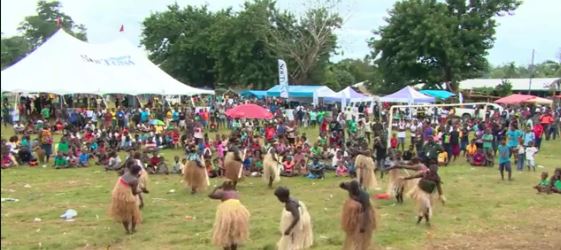
Negotiators from Pacific Island countries will try to salvage a deal over tuna fishing rights with the United States.
For decades, the US has had a deal that allows its boats to fish freely across the South Pacific. But now American tuna companies say the agreement is costing them too much money.





 Sarah Malik